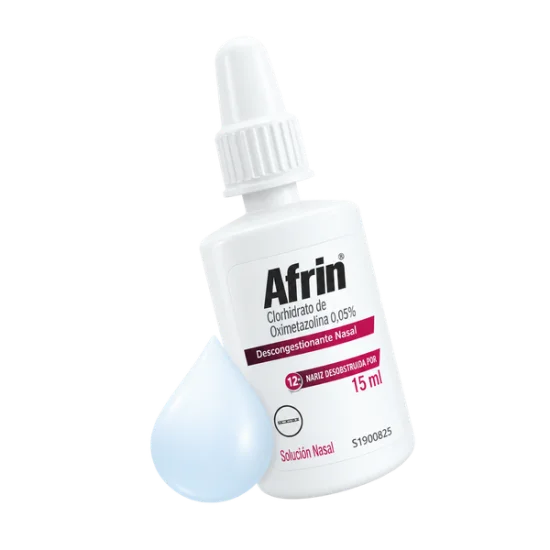
I used Afrin during a bad cold and noticed easier breathing within a few minutes. I used it only for the short course confirmed before starting, and the main drawback was mild dryness at night.
30 Oct 2026
Afrin
Afrin contains oxymetazoline hydrochloride, a topical alpha-adrenergic nasal decongestant. Afrin is intended for temporary relief of blocked nasal passages linked with colds, sinusitis, and allergic…
Afrin contains oxymetazoline hydrochloride, a topical alpha-adrenergic nasal decongestant. Afrin is intended for temporary relief of blocked nasal passages linked with colds, sinusitis, and allergic rhinitis. It works by narrowing swollen blood vessels in the nasal lining, with relief often beginning within minutes.
Product information
Afrin is a nasal decongestant spray containing oxymetazoline hydrochloride. The medicine acts locally inside the nose to reduce swelling of the nasal mucosa and improve airflow. Oxymetazoline belongs to the topical sympathomimetic decongestant class.
Ingredients
Active Ingredient Composition
The active ingredient is oxymetazoline hydrochloride. The product belongs to the nasal decongestant category and is administered through the nose as a spray.
The concentration is important when determining the appropriate regimen. Confirm the selected strength and age suitability with a healthcare professional before starting. Do not transfer the liquid into another container or combine it with another nasal product.
Therapeutic indications
Afrin is commonly used for temporary congestion associated with:
- The common cold
- Acute sinus congestion
- Allergic rhinitis
- Nasal blockage caused by swollen nasal tissues
Directions for use
Afrin is used through the nose. The selected regimen should be confirmed with a healthcare professional before starting because the suitable strength and frequency depend on age and medical history.
Use the spray as follows:
- Clear the nostrils gently before administration.
- Keep the head in a neutral or slightly forward position.
- Place the nozzle just inside one nostril.
- Direct the spray away from the nasal septum.
- Breathe in gently while administering the spray.
- Repeat in the other nostril if included in the confirmed regimen.
- Keep the treatment short and do not continue beyond the recommended duration.
Do not tilt the head far backwards. That position encourages the liquid to run into the throat, where it may cause an unpleasant taste or irritation.
Do not share a nasal spray. Sharing can transfer microorganisms between users. Avoid forceful sniffing immediately after spraying because it can move the liquid into the throat instead of leaving it on the nasal mucosa.
The TGA and other medicines regulators treat topical nasal decongestants as short-duration products. Prolonged or repeated use increases the likelihood of rebound congestion and local irritation [2].
Missed or Excessive Applications
If an application is missed, use the next scheduled application only when needed. Do not compensate with extra sprays. More frequent use does not reliably improve congestion and may increase adverse effects.
Too much oxymetazoline can produce marked nasal dryness, headache, tremor, fast heartbeat, or changes in blood pressure. Accidental swallowing by a child requires prompt medical advice, especially if drowsiness, weakness, vomiting, or breathing changes develop.

When not to use it
Afrin requires medical review before use in people with:
- Uncontrolled or severe hypertension
- Significant cardiovascular disease
- Narrow-angle glaucoma
- Hyperthyroidism
- Diabetes requiring close blood-pressure monitoring
- Prostate enlargement with urinary difficulty
- Known sensitivity to oxymetazoline or related sympathomimetics
- Recent nasal surgery or significant nasal injury
People taking monoamine oxidase inhibitors, tricyclic antidepressants, or other medicines that increase sympathetic activity need specific advice before using oxymetazoline. Combining Afrin with an oral decongestant such as phenylephrine may increase the likelihood of cardiovascular effects.
When this is not for you
Not for you if a clinician has advised against topical sympathomimetics or you have a listed contraindication.
Pregnancy and breastfeeding require individual assessment. Limited systemic absorption does not eliminate the need to consider dose, treatment duration, blood pressure, and other medicines.
Unwanted effects
Local nasal effects are the most common problems. These can include dryness, burning, stinging, sneezing, increased discharge, crusting, and minor nosebleeds. The risk rises when the spray is used too often or directed at the nasal septum.
Some users may develop headache, restlessness, sleep difficulty, palpitations, or a temporary increase in blood pressure. These effects are more concerning in people with hypertension, heart disease, thyroid disease, or sensitivity to sympathomimetic medicines.
Serious symptoms require urgent medical attention:
- Chest pain
- Fainting
- Severe or irregular heartbeat
- Sudden severe headache
- Confusion or extreme drowsiness
- Difficulty breathing
- Severe weakness after accidental swallowing
A blocked nose that becomes worse after several days may represent rhinitis medicamentosa rather than treatment failure. Stop repeated unscheduled applications and obtain medical advice about another approach.
One practical detail is easy to miss: frequent wiping or forceful cleaning of the nostril can worsen irritation around the nozzle area. Gentle cleaning is preferable.
Mechanism of action
Oxymetazoline hydrochloride is a direct-acting alpha-adrenergic receptor agonist. It binds to receptors on small blood vessels within the nasal mucosa. These vessels constrict, reducing blood flow and fluid leakage into the surrounding tissue.
Swollen nasal tissue takes up less space once the vessels narrow. Air can then pass more freely through the nasal passages. Reduced mucosal swelling may also decrease the sensation of pressure and improve nasal breathing during a cold or episode of allergic rhinitis.
The effect is local, but a small amount of oxymetazoline may be absorbed into the circulation. This explains why sensitive individuals can experience effects such as palpitations, headache, or a rise in blood pressure. The FDA and the Medicines and Healthcare products Regulatory Agency describe oxymetazoline nasal products as short-term decongestants with vasoconstrictor activity [1].
Common mistakes
Frequent mistakes include:
- Using the spray every few hours because congestion returns.
- Continuing it for a week after the cold improves.
- Spraying towards the nasal septum.
- Tilting the head backwards and swallowing the liquid.
- Combining Afrin with an oral decongestant without checking the active ingredients.
- Giving an adult-strength product to a child.
- Sharing the bottle with another household member.
- Treating persistent congestion as a simple cold without medical review.
- Repeating an application after forgetting whether it was already used.
A symptom diary can help when congestion keeps returning. Record the time of each application and whether the nose was blocked on one or both sides. This can reveal escalating use before rebound congestion becomes severe.
Comparison
Afrin provides local vasoconstriction, while oral decongestants act throughout the body. Saline products work through moisturising and mechanical clearance rather than receptor stimulation.
| Approach | Main action and practical difference |
|---|---|
| Afrin with oxymetazoline | Local alpha-adrenergic vasoconstriction; relief often begins within minutes; short-duration use is essential because rebound congestion can occur. |
| Oral decongestant such as phenylephrine | Systemic decongestant action; may be less suitable for people sensitive to blood-pressure or heart-rate effects. |
| Saline nasal spray or rinse | Moisturises and helps clear mucus; it does not produce vasoconstriction or rebound congestion, but relief from marked swelling may be less immediate. |
Topical oxymetazoline can act faster at the site of blockage than an oral product. Its main limitation is the strict duration restriction. Oral decongestants may create more systemic exposure, while saline has a gentler mechanism but may not open a severely swollen nose as quickly.
The WHO describes saline cleansing and supportive nasal care as useful measures for symptom management, while pharmacological decongestants should be selected with attention to individual risks [3].
What doctors say
In clinical practice, doctors generally view oxymetazoline as a useful short-term option when nasal swelling is the main cause of breathing difficulty. The benefit is usually clear: the nose opens quickly, and sleep or eating may become easier during an acute cold.
The limitation is duration. A spray that works well on the first day can become counterproductive when used repeatedly over many days. Physicians also look for the cause of recurrent congestion instead of extending a decongestant course.
A doctor will usually ask about blood pressure, heart rhythm, glaucoma, thyroid disease, urinary symptoms, pregnancy, and other cold medicines. The question is not only whether Afrin opens the nose, but whether its vasoconstrictor action fits the person’s medical history.
Patients sometimes assume that a topical spray has no systemic effects. That assumption is unsafe for people with cardiovascular risk or those using interacting medicines.
What customers often ask
Can people under 18 use Afrin?
Age suitability depends on the formulation and strength. Children should use oxymetazoline only when the product is appropriate for their age and the regimen has been confirmed by a healthcare professional. The FDA paediatric safety information for topical decongestants, reviewed in 2023, highlights the danger of dosing errors and accidental swallowing [4]. Never transfer an adult regimen to a child. Caregivers should also verify the formulation and strength before each use.
Which condition rules out Afrin?
Uncontrolled hypertension, serious cardiovascular disease, narrow-angle glaucoma, and known sensitivity to oxymetazoline are conditions that may rule out use or require a different treatment. The vasoconstrictor action can affect blood pressure, heart rate, and eye pressure in susceptible people. TGA guidance supports individual assessment when a topical sympathomimetic is used by someone with these conditions. A doctor should review the treatment before starting if any of them applies.
How long does one Afrin application keep working?
Oxymetazoline nasal products commonly provide relief for several hours, and some formulations are designed for dosing at approximately twelve-hour intervals. The exact duration varies with strength, nasal inflammation, and individual response. FDA product information reviewed in 2023 describes oxymetazoline as a prolonged-acting topical decongestant. Do not repeat an application early simply because the nose begins to feel blocked again.
How soon does Afrin start working?
Nasal airflow may improve within minutes because oxymetazoline constricts dilated blood vessels directly in the nasal mucosa. Thick mucus, severe inflammation, or a structural blockage can make the improvement less complete. EMA pharmacology information describes the rapid local action of alpha-adrenergic nasal decongestants. A lack of improvement after appropriate use suggests that congestion may have another cause.
What should be discussed with a doctor before starting Afrin?
Discuss blood pressure, heart disease, glaucoma, thyroid disease, diabetes, urinary difficulty, pregnancy, breastfeeding, and recent nasal surgery. Provide a list of medicines, including antidepressants, oral decongestants, and non-prescription cold remedies. The TGA safety framework, current in 2026, supports checking for additive sympathomimetic effects before treatment. Also confirm the appropriate strength and regimen for the intended user.
Can alcohol be used while taking Afrin?
Alcohol does not create the same direct interaction as a monoamine oxidase inhibitor, but it may worsen dizziness, headache, palpitations, or poor judgement about repeated dosing. People with hypertension or heart disease should be more cautious because alcohol can also affect cardiovascular control. WHO clinical safety information from 2022 supports limiting factors that may worsen adverse symptoms during acute illness. Avoid alcohol if Afrin causes dizziness, a racing heartbeat, or marked discomfort.
What happens when Afrin is stopped, and does it need tapering?
Afrin does not usually require tapering after a short, recommended course. Temporary worsening of blockage can occur if the spray has been used repeatedly for too long, which is consistent with rebound congestion. EMA information from 2021 describes rhinitis medicamentosa as a consequence of prolonged topical decongestant use. Saline care and medical advice may help when stopping after extended use; escalating the spray is not a tapering method.
Do you offer anonymous delivery?
Your order will be securely packed and shipped within 24 hours. This is exactly what your package will look like (images of an actual item sent). It has the size and look of a regular private letter (24x11x0.7 cm) and its contents cannot be seen.
Sources
- U.S. Food and Drug Administration (2023). Drug Facts Label — Afrin (oxymetazoline hydrochloride) nasal spray
- Therapeutic Goods Administration (2022). Product Information — oxymetazoline hydrochloride nasal spray
- World Health Organization (2022). Consolidated guideline on self-care interventions for health and well-being
- U.S. Food and Drug Administration (2023). Drug Facts Label — over-the-counter cough, cold, and allergy medicines for children
How Buyers Rate Afrin
Based on 4 reviews
The spray helped me sleep during the first two nights of sinus congestion. I also have treated hypertension, so I checked the plan with my doctor rather than using extra applications when the blockage returned.
The first two nights 7 Nov 2026I used a decongestant spray for several days and then felt more blocked than before. Stopping the repeated applications was uncomfortable, but continuing the spray made the cycle worse.
Several days 9 Oct 2026Afrin opened one side of my nose quickly during a cold, though it caused stinging after repeated use. Directing the nozzle away from the septum made the next application more comfortable.
22 Oct 2026