prescribed dose, several weeks, he used Atrovent for COPD-related tightness. He felt less chest tightness during morning activity, although dry mouth was noticeable after the first few days.
Several weeks 1 Nov 2026
Atrovent
It relaxes airway muscle and reduces excessive bronchial secretions, helping airflow when prescribed as part of a respiratory treatment plan. Atrovent is used in respiratory care for bronchospasm…
It relaxes airway muscle and reduces excessive bronchial secretions, helping airflow when prescribed as part of a respiratory treatment plan. Atrovent is used in respiratory care for bronchospasm associated with COPD and, in selected cases, asthma.
Product information
Ipratium bromide, the active ingredient in Atrovent, is an inhaled anticholinergic bronchodilator for adults and children with reversible bronchospasm or chronic obstructive pulmonary disease (COPD).
Ingredients
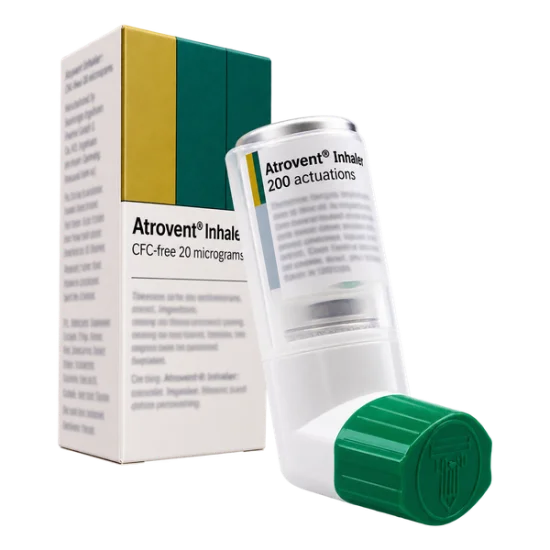
Atrovent Inhaler contains ipratium bromide as its active ingredient. It is an inhaled anticholinergic bronchodilator supplied for 200 actuations and is used to help relax airway muscle and reduce excessive bronchial secretions.
Therapeutic indications
Atrovent Inhaler is prescribed mainly for airflow limitation in COPD, including chronic bronchitis and emphysema. It may also be included in selected asthma treatment plans when anticholinergic bronchodilation is clinically appropriate. The Therapeutic Goods Administration recognises ipratropium as an inhaled bronchodilator used in respiratory disease management [1].
In clinical practice, doctors often use Atrovent as part of a broader plan that may include a rapid bronchodilator, an inhaled corticosteroid, oxygen therapy, pulmonary rehabilitation, or treatment for an underlying infection. The choice depends on the diagnosis and the pattern of symptoms.
Atrovent may reduce wheezing, chest tightness, and breathlessness caused by bronchial narrowing. It does not treat every cause of shortness of breath. Sudden severe breathing difficulty, blue lips, confusion, or inability to speak in full sentences requires urgent medical assessment.
Ipratropium is also used in a nasal spray formulation for watery rhinorrhoea, including symptoms associated with perennial rhinitis. The nasal product acts on the mucous glands inside the nose rather than delivering medicine into the lower airways.
Atrovent Inhaler and Atrovent nasal spray use the same active substance but have different routes, devices, and clinical purposes. An inhaler is directed into the mouth and lungs. A nasal spray is directed into the nostrils and mainly reduces watery nasal discharge.
Nasal ipratropium does not provide the same treatment as an inhaled bronchodilator for wheezing or bronchospasm. The formulations should not be substituted for one another.
Clinical studies indexed by the National Library of Medicine have examined ipratropium for rhinorrhoea and airway symptoms, with results depending on the formulation and condition being treated [2].

Directions for use
The prescribed amount is individualised rather than fixed for every person. Use Atrovent only through the inhaler supplied for this formulation and follow the dosing schedule issued for the patient’s condition.
- Shake the inhaler if the device instructions for that product require shaking.
- Remove the cap and check that the mouthpiece is clear.
- Breathe out gently, away from the device.
- Seal the lips around the mouthpiece.
- Begin a slow, deep breath while releasing the prescribed actuation.
- Hold the breath briefly if able, then breathe out slowly.
- Replace the cap after use.
- If more than one actuation is prescribed, allow the interval specified by the prescriber before repeating it.
A missed dose should generally be taken when remembered unless the next scheduled dose is close. Do not double the next dose to compensate. If the medicine seems less helpful than usual, the problem may reflect worsening airway disease, poor inhaler technique, or another illness.
Do not stop a regular respiratory treatment abruptly without a clinical reason. Atrovent usually does not require a taper, but stopping may allow wheeze, breathlessness, or mucus symptoms to return.
When not to use it
You have had a serious allergic reaction to ipratropium, atropine, or related anticholinergic substances.
You have experienced severe breathing deterioration immediately after using ipratropium.
You have narrow-angle glaucoma and cannot prevent the aerosol from reaching your eyes.
You have urinary retention, significant bladder-outflow obstruction, or severe prostate-related difficulty passing urine without medical review.
Ipratropium can add to the anticholinergic effects of medicines used for bladder symptoms, bowel spasms, motion sickness, Parkinsonian symptoms, or some psychiatric conditions.
Combining several inhaled bronchodilators may be appropriate in COPD, but the combination should be deliberate. Unsupervised use with other anticholinergic inhalers can increase dry mouth, blurred vision, constipation, and urinary symptoms.
When this is not for you
NOT for you if
- The inhaler is intended for a child who cannot use the device safely without appropriate supervision or an approved spacer.
- You have glaucoma, prostate enlargement, cystic fibrosis, pregnancy, breastfeeding, heart rhythm problems, or difficulty coordinating inhaler use.
- You cannot prevent the aerosol from reaching your eyes.
Unwanted effects
Common effects include dry mouth, throat irritation, cough, headache, dizziness, nausea, and an unpleasant taste. These effects are often linked to local anticholinergic action and may improve as technique becomes more consistent.
Some people experience palpitations, constipation, difficulty passing urine, or blurred vision. Severe eye pain, coloured rings around lights, sudden visual change, facial swelling, or worsening breathing after an actuation requires prompt medical attention.
The Australian product information describes paradoxical bronchospasm as a rare but serious reaction. This means the airways tighten immediately after inhalation rather than opening. Stop using the inhaler and seek urgent care if breathing suddenly becomes worse after a dose [3].
Mechanism of action
Atrovent Inhaler contains ipratropium bromide and delivers it directly into the airways. Ipratropium belongs to the inhaled anticholinergic class, also called muscarinic-receptor antagonists.
Acetylcholine is a chemical messenger that can narrow the bronchial tubes and stimulate mucus production. Ipratropium blocks muscarinic receptors in the airway walls, reducing this nerve-mediated tightening. The bronchial smooth muscle then relaxes, allowing air to move more freely.
Role of Ipratropium Bromide in Airway Dilatation
Airway dilatation means widening narrowed bronchial passages. Ipratropium reduces vagal nerve stimulation of the airway muscle, which can decrease bronchoconstriction and limit watery secretions.
Common mistakes
- Breathing in too quickly after releasing the actuation.
- Failing to coordinate actuation with inhalation.
- Spraying towards the eyes.
- Taking extra actuations because breathlessness has not improved immediately.
- Using a nasal spray formulation for lower-airway symptoms.
- Sharing an inhaler between people.
- Ignoring worsening breathlessness because the inhaler still produces a spray.
- Forgetting to clean the mouthpiece according to the device instructions.
- Stopping regular treatment as soon as symptoms improve.
- Treating Atrovent as a substitute for every other prescribed inhaler.
A blocked mouthpiece can change the delivered dose. Cleaning should follow the device-specific instructions, and the inhaler should be kept dry between uses. Do not place the inhaler in water unless the instructions for that exact device permit it.
Comparison
| Treatment category | Main role | Practical distinction |
|---|---|---|
| Atrovent inhaler | Anticholinergic bronchodilation | Reduces cholinergic airway narrowing and secretions |
| Short-acting beta₂ bronchodilator | Rapid airway-muscle relaxation | Acts through beta₂ receptors rather than muscarinic receptors |
| Inhaled corticosteroid | Airway inflammation control | Used as a preventer rather than immediate bronchodilation |
Asthma relief inhalers and asthma preventer inhalers do different jobs. Atrovent can support bronchodilation, yet it does not replace an anti-inflammatory preventer when that treatment has been prescribed.
What doctors say
Respiratory clinicians usually judge Atrovent by changes in breathlessness, wheeze, exercise tolerance, and rescue-treatment requirements rather than by one isolated dose. A patient who receives only partial relief may need a technique review or a revised treatment plan.
Doctors also distinguish persistent airway inflammation from reversible bronchoconstriction. Atrovent can relax airway muscle, but it does not replace corticosteroid treatment when inflammation is driving recurrent asthma symptoms.
A clinician will often ask how the inhaler is used, not just whether it is being used. Incorrect timing between actuation and inhalation can make a prescribed treatment appear ineffective. The FDA prescribing information also emphasises device technique, paradoxical bronchospasm, and ocular exposure precautions [4].
What customers often ask
What happens when stopping Atrovent, and does it need tapering?
Atrovent does not usually require a gradual taper because it is a bronchodilator rather than a systemic corticosteroid. Stopping regular treatment can allow bronchospasm, wheeze, or breathlessness to return, especially in COPD. The TGA product information (2023) supports using ipratropium according to the prescribed respiratory plan rather than changing treatment abruptly without clinical direction.
Can Atrovent be used during pregnancy or breastfeeding?
Pregnancy and breastfeeding require an individual risk–benefit assessment based on symptom severity and available alternatives. Inhaled ipratropium has limited systemic absorption compared with oral anticholinergic treatment, yet the decision still belongs within the patient’s maternity and respiratory care plan. The EMA assessment framework (2021) for inhaled medicines considers maternal benefit, fetal exposure, and infant exposure when evaluating use during these periods.
What should happen if the expected breathing improvement does not come?
Check inhaler technique first, because poor coordination can leave much of the dose in the mouth. Persistent or worsening breathlessness may indicate infection, severe bronchospasm, heart disease, or another cause that Atrovent cannot correct. WHO respiratory-care principles (2023) support urgent assessment for severe breathlessness, cyanosis, confusion, or inability to speak normally.
How should the Atrovent inhaler be cleaned and handled?
Keep the mouthpiece free of dust and medicine residue, and clean it using the method specified for the exact device. Do not immerse the canister or use sharp objects to clear the opening. Australian TGA device guidance (2023) places emphasis on correct handling, because a blocked or damaged mouthpiece can affect aerosol delivery.
Can alcohol be used while taking Atrovent?
There is no established direct alcohol interaction that routinely prevents prescribed inhaled ipratropium use. Alcohol can still worsen reflux, dehydration, dizziness, or the perception of breathlessness in some people, which may complicate symptom assessment. The NHS respiratory-medicine approach (2024) is to judge alcohol use by individual symptoms and concurrent medicines, especially when dizziness or poor coordination is present.
Can Atrovent be combined with other medicines or supplements?
The most relevant combination concern is use with other anticholinergic medicines, including some bladder, bowel, motion-sickness, and Parkinsonian treatments. Combined effects may increase dry mouth, blurred vision, constipation, fast heartbeat, or urinary retention. The FDA label (2020) identifies additive anticholinergic effects as a prescribing consideration, so every regular medicine and supplement should be included in the medication review.
Do you offer anonymous delivery?
Your order will be securely packed and shipped within 24 hours. This is exactly what your package will look like (images of an actual item sent). It has the size and look of a regular private letter (24x11x0.7 cm) and its contents cannot be seen.
Sources
- Therapeutic Goods Administration (TGA) (2023). Australian Product Information — Atrovent Inhaler (ipratropium bromide)
- National Library of Medicine (NLM) (2022). PubMed: ipratropium bromide studies
- European Medicines Agency (EMA) (2021). Summary of Product Characteristics (SmPC) — ipratropium bromide
- U.S. Food and Drug Administration (FDA) (2020). Atrovent HFA — prescribing information
How Buyers Rate Atrovent
Based on 4 reviews
prescribed dose, during episodes of bronchospasm, he used ipratropium. The inhaler helped when his technique was slow, but he initially thought it was failing because he inhaled too quickly.
During episodes of bronchospasm 9 Nov 2026prescribed dose, during cold-weather flare-ups, he reported easier breathing. He disliked the taste and needed to pay closer attention to keeping the spray away from his eyes.
During cold-weather flare-ups 12 Oct 2026prescribed dose, as directed in his COPD plan, he found Atrovent useful but still experienced breathlessness during exertion. His clinician adjusted the wider treatment plan rather than increasing doses independently.
As directed in his COPD plan 27 Oct 2026