Therapeutic indications
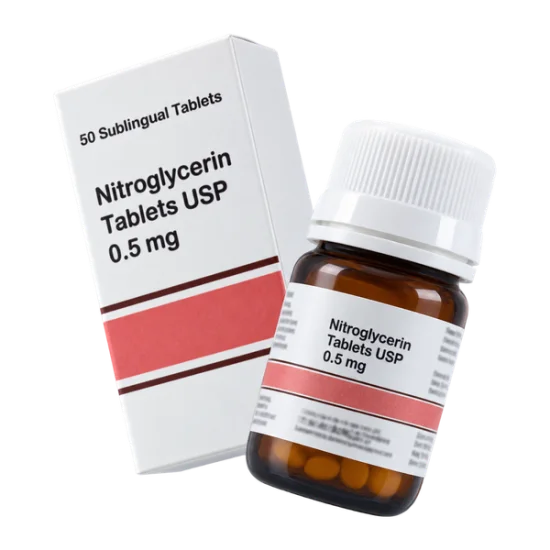
Nitroglycerin belongs to the nitrate group of antianginal drugs. It is used mainly for the rapid treatment of angina pectoris, the pressure or pain that occurs when the heart muscle does not receive enough oxygen-rich blood.
The main therapeutic effects are:
- Relief of acute angina symptoms.
- Reduced cardiac workload.
- Lower myocardial oxygen demand.
- Improved balance between oxygen supply and demand in the heart.
- Rapid action through the sublingual route.
Sublingual nitroglycerin does not remove the underlying cause of coronary artery disease. It treats the vascular component of an angina episode. New, severe, prolonged, or changing chest pain requires emergency assessment because it may represent acute coronary syndrome rather than stable angina.
The FDA prescribing information describes these haemodynamic risks and contraindications [1].
Directions for use
Nitroglycerin tablets are placed under the tongue, where the active substance can pass through the oral mucosa into the bloodstream. This route avoids much of the first-pass hepatic metabolism that affects swallowed medicines. The result is a faster onset than an ordinary oral tablet intended for gastrointestinal absorption.
The dose is decided individually, taking age, other medicines, blood pressure, heart disease, and general health into account.
Use involves these practical steps:
- Sit down before taking the tablet.
- Place the tablet beneath the tongue.
- Allow it to dissolve without chewing or swallowing it immediately.
- Avoid eating, drinking, or talking until it has dissolved.
- Do not stand suddenly after administration.
- Follow the emergency plan supplied by the prescribing clinician for persistent chest pain.
If chest pain is severe, lasts longer than expected, returns quickly, or is accompanied by breathlessness, sweating, collapse, nausea, or pain spreading to the arm or jaw, contact emergency services immediately. Do not drive yourself.
Sublingual tablets are intended for acute episodes. Transdermal patches and long-acting oral nitrates serve different purposes, such as prevention over several hours. A patch is not a substitute for a sublingual tablet during sudden symptoms, and a sublingual tablet does not provide all-day prevention.
| Form |
Main role |
Time profile |
| Sublingual tablet |
Acute angina relief |
Rapid onset, relatively short duration |
| Transdermal patch |
Prevention of recurrent symptoms |
Slower, sustained delivery |
When not to use it
Nitroglycerin is not suitable for everyone. This medicine is not for you if any of the following apply:
- You have taken a phosphodiesterase-5 inhibitor, such as sildenafil, tadalafil, vardenafil, or avanafil, within the clinically restricted time period.
- You use riociguat or another soluble guanylate cyclase stimulator.
- You have severe hypotension, shock, or circulatory collapse.
- You have severe anaemia or known methemoglobinaemia.
- You have raised intracranial pressure unless a specialist has directed treatment.
- You have a known allergy to nitroglycerin or another nitrate.
- You have chest pain caused by a condition in which reducing cardiac filling could worsen circulation, such as some right-sided myocardial infarctions.
The interaction with phosphodiesterase-5 inhibitors is a major safety issue. Both medicines increase vasodilator signalling, and their combined effect can cause profound hypotension, loss of consciousness, myocardial ischaemia, or death. Do not use nitrate medicine after erectile-dysfunction treatment unless emergency clinicians have assessed the situation and given specific instructions.
Other blood-pressure-lowering agents, alpha-blockers, alcohol, diuretics, and some medicines used for heart failure can add to the blood-pressure effect. Severe dehydration from vomiting, diarrhoea, fever, or inadequate fluid intake can also make a normal dose poorly tolerated.
Pregnancy and breastfeeding require an individual risk assessment. The prescriber needs to know about pregnancy, planned pregnancy, breastfeeding, anaemia, glaucoma, recent head injury, heart-valve disease, and kidney or liver problems before selecting treatment.
When this is not for you
This medicine may not be suitable if you have very low blood pressure, circulation problems, severe anaemia, raised pressure in the skull, or an allergy to nitrates. It is also unsafe to use after certain erectile-dysfunction medicines or with riociguat. Ask a clinician before use if you are pregnant or breastfeeding, dehydrated, or have glaucoma, recent head injury, heart-valve disease, or kidney or liver problems.
Unwanted effects
Nitroglycerin causes blood-vessel relaxation, so its adverse effects often reflect a fall in vascular resistance or blood pressure. Headache is common because cerebral blood vessels may dilate. The headache can feel throbbing and may appear soon after administration.
Other possible effects include:
- Dizziness or light-headedness.
- Flushing.
- Weakness.
- Nausea.
- Palpitations.
- Postural hypotension.
- Fainting, known medically as syncope.
- A rapid heartbeat caused by reflex responses to lower blood pressure.
A headache after sublingual nitroglycerin does not automatically mean an allergic reaction. It often reflects the intended nitrate effect, though severe or persistent pain needs medical review. Sitting or lying down reduces the risk of falling while the blood-pressure effect develops.
Hypotension may be more pronounced in older adults, people who are dehydrated, and those taking several blood-pressure-lowering medicines. Alcohol can intensify vasodilation and increase dizziness or fainting risk. The combination of nitrates with sildenafil, tadalafil, vardenafil, avanafil, or other phosphodiesterase-5 inhibitors can produce a dangerous fall in blood pressure.
Rare but serious reactions include severe hypotension, collapse, methemoglobinaemia, and clinically significant bradycardia or tachycardia. Emergency help is needed for fainting, blue-grey lips, severe breathlessness, confusion, or chest pain that does not settle.
Do not try to “walk off” dizziness after a dose. Sit or lie flat, keep your head supported, and obtain urgent help if symptoms are severe or the person becomes difficult to wake.
Common mistakes
Several practical mistakes can reduce the benefit of sublingual nitroglycerin or increase risk:
- Swallowing the tablet immediately instead of allowing it to dissolve under the tongue.
- Standing up quickly after taking a dose.
- Using it after a phosphodiesterase-5 inhibitor.
- Treating repeated or worsening attacks at home without urgent assessment.
- Taking extra doses outside the agreed clinical plan.
- Assuming headache means the medicine has caused an allergy.
- Combining it with alcohol when already prone to low blood pressure.
- Failing to mention nitrate use before receiving another vasodilator.
- Driving after a dose while dizzy or light-headed.
Another frequent mistake is using a nitrate to treat every form of chest discomfort. Reflux, pulmonary disease, muscle pain, aortic disease, and cardiac emergencies can produce similar symptoms. Persistent or atypical pain should be managed as a medical emergency.
Comparison
Nitroglycerin and isosorbide dinitrate are both nitrates used in angina pectoris, but their delivery profiles differ. Nitroglycerin sublingual tablets are suited to rapid symptom relief. Isosorbide dinitrate may be used in oral regimens intended for prevention or scheduled treatment, depending on its formulation and the clinician’s plan.
| Treatment category |
Typical role |
Main limitation |
| Sublingual nitroglycerin |
Rapid relief during an acute angina episode |
Short duration and headache or hypotension |
| Longer-acting nitrate therapy |
Prevention of recurrent angina |
Requires nitrate-free planning to limit tolerance |
| Non-nitrate antianginal therapy |
Long-term control of oxygen demand or coronary tone |
Choice depends on heart rate, blood pressure, rhythm, and comorbidities |
Nitrate tolerance can develop when exposure is continuous. Long-acting treatment plans often include a daily nitrate-free interval, while sublingual nitroglycerin is used intermittently for attacks. The timing must be prescribed rather than improvised, because uncontrolled angina may indicate worsening coronary disease.
Beta-blockers and calcium-channel blockers may be used alongside or instead of nitrate therapy. Betaxolol belongs to the beta-adrenoceptor antagonist group and can reduce heart rate and myocardial oxygen demand. Nifedipine is a calcium-channel blocker used in hypertension and selected angina regimens; its suitability depends on blood pressure, heart rate, and the clinical pattern of disease.
Antianginal drugs address different parts of the oxygen-supply problem. Nitroglycerin mainly reduces preload and cardiac workload through venodilation. Beta-blockers reduce sympathetic stimulation, heart rate, and contractility. Calcium-channel blockers relax arterial smooth muscle and can reduce afterload, while some members also slow conduction through the heart.
A doctor may combine medicines when one mechanism does not provide enough symptom control. The combination requires attention to low blood pressure, slow heart rate, conduction problems, fluid status, and exercise tolerance. Nifedipine and other dihydropyridine calcium-channel blockers may cause flushing, ankle swelling, or palpitations, while beta-blockers may cause fatigue, slow pulse, or reduced exercise capacity.
What doctors say
In clinical practice, doctors treat the response to nitroglycerin as useful information, not as proof that every episode is harmless. Relief after a nitrate can occur with several causes of chest discomfort, so it does not by itself confirm stable angina.
Physicians usually focus on three points:
- Whether the person has a clear diagnosis and an agreed emergency plan.
- Whether the blood pressure remains adequate after dosing.
- Whether attacks are becoming more frequent, prolonged, or difficult to relieve.
A cardiology review is warranted when sublingual tablets are needed more often than usual. The treatment plan may require investigation for coronary artery disease, anaemia, valve disease, arrhythmia, or heart failure.
One detail that often gets missed is the medication history before emergency treatment. Tell paramedics or emergency clinicians the time of the last nitroglycerin dose and whether sildenafil, tadalafil, vardenafil, avanafil, or riociguat has been used.