I used one tablet daily for about eight months. The crown looked less exposed in photographs, although the front hairline changed very little. I also noticed lower libido during the first few weeks, which settled without stopping.
About eight months 19 Oct 2026
Propecia
Propecia is intended for adult men with male pattern hair loss. It lowers scalp dihydrotestosterone (DHT), helping slow follicle miniaturisation and preserve hair.
Product information
Finasteride, the active ingredient of Propecia, is a 5-alpha-reductase type II inhibitor for adult men with male pattern hair loss.
Ingredients
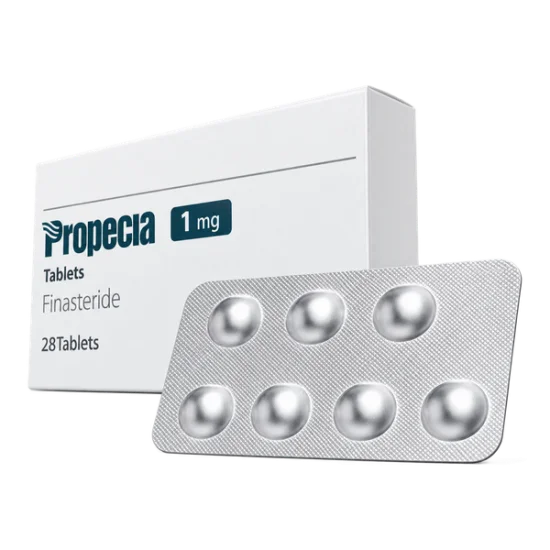
Propecia contains finasteride in an oral tablet. This is the hair-loss dose used for male androgenetic alopecia, a hereditary condition driven partly by sensitivity to DHT. Propecia is intended for adult men and is supplied as tablets.
The treatment target is the scalp rather than the hair shaft. Finasteride does not repair damaged hair immediately, and it does not create instant density. Its role is to reduce the hormonal pressure that causes susceptible follicles to become smaller over time.
Therapeutic indications
Male pattern hair loss, also called androgenetic alopecia, develops when genetically sensitive follicles respond to circulating androgens. The frontal hairline, temples and crown are common areas of change, although the pattern varies between men.
Finasteride is most useful while affected follicles remain capable of producing hair. It cannot restore a follicle that has permanently lost its capacity to grow. Clinical trials of finasteride in men with androgenetic alopecia found improvements in hair counts and photographic assessments over sustained treatment periods. [1]
Directions for use
The regimen for the chosen strength should be confirmed with a healthcare professional before starting.
- Swallow the tablet with water.
- Take it at roughly the same time each day.
- It may be taken with food or on an empty stomach.
- Do not take more than one tablet in a day if a dose is missed.
- If you remember a missed dose later that day, take it when convenient; if it is nearly time for the next dose, skip the missed dose and return to the usual schedule.
- Do not double the next dose.
The treatment is intended for continuous use. Stopping and restarting repeatedly can make it difficult to judge the response, while the biological process causing hair loss continues when DHT suppression stops.
Do not crush or chew Propecia tablets. The tablet should be swallowed intact. Women who are pregnant or may become pregnant should not handle crushed or broken tablets because finasteride can be absorbed through the skin and may affect development of a male fetus. [2]
When not to use it
It is contraindicated in women who are pregnant or may become pregnant because finasteride can interfere with development of the external genitalia of a male fetus.
- Children and adolescents
- Men with a known allergy to finasteride or any tablet ingredient
- Anyone who has developed serious allergic symptoms after finasteride
- Men with unexplained hair loss that has not been clinically assessed
When this is not for you
Propecia is not for women or children. Propecia is NOT for you if you are pregnant or may become pregnant, are under 18, have a finasteride allergy, or have unexplained hair loss requiring assessment. Women who are pregnant or may become pregnant must not handle crushed or broken tablets.
Tell the prescribing clinician about liver disease, mood disorders, sexual dysfunction, fertility concerns and all medicines or supplements being used. Finasteride is extensively metabolised in the liver, so hepatic impairment may affect treatment decisions.
Do not use Propecia alongside another finasteride-containing product unless specifically directed.
Unwanted effects
Clinical trials reported sexual adverse reactions in a small proportion of men taking finasteride 1 mg. Reported events included reduced libido, erectile dysfunction and reduced ejaculate volume. In controlled studies, these effects were generally reported more often with finasteride than placebo, although the absolute difference was modest. [3]
Possible adverse effects include:
- Reduced sexual desire
- Difficulty achieving or maintaining an erection
- Reduced semen volume
- Breast tenderness or enlargement
- Testicular discomfort
- Rash or allergic swelling
- Depressed mood or mood changes
Sexual symptoms often appeared during the first year in clinical studies and improved in many men after stopping treatment. Persistent symptoms have also been reported after discontinuation, although the frequency and causal relationship remain subjects of continuing medical discussion. Any new sexual symptom should be recorded and discussed promptly rather than ignored for months.
Mood changes deserve attention. Depressed mood, anxiety, suicidal thoughts or marked emotional changes require prompt medical assessment. Urgent help is required for suicidal thoughts, facial or throat swelling, breathing difficulty, or a severe skin reaction.
Finasteride reduces serum prostate-specific antigen, or PSA, by approximately half in many men receiving 1 mg daily. A doctor interpreting a PSA result must know that finasteride is being taken, because the measured value may need clinical adjustment. This matters even when Propecia is being used for hair loss.
Mechanism of action
Finasteride is a selective 5-alpha-reductase type II inhibitor. This enzyme converts testosterone into dihydrotestosterone. By reducing DHT around susceptible scalp follicles, finasteride helps reduce the progressive shortening and thinning of the hair-growth cycle.
Common mistakes
Several practical errors make Propecia harder to assess:
- Expecting visible regrowth within a few weeks
- Taking extra tablets after a missed dose
- Stopping after two or three months because the mirror looks unchanged
- Comparing wet hair with dry hair in different lighting
- Forgetting to mention finasteride before PSA interpretation
- Ignoring new depression, suicidal thoughts or allergic symptoms
- Allowing a pregnant woman to handle a crushed or broken tablet
- Combining it with another finasteride product without medical direction
- Treating every type of hair shedding as male pattern hair loss
The most common expectation problem is confusing stabilisation with regrowth. Preserving existing density may represent a useful treatment response even when the hairline does not visibly move forward.
Comparison
The choice of treatment depends on the pattern of loss, the desired outcome, medical history and tolerance of possible adverse effects. Propecia works through DHT reduction, while other approaches may stimulate follicles directly or address the appearance of hair loss without changing androgen activity.
| Approach | Main biological action |
|---|---|
| Finasteride 1 mg | Reduces conversion of testosterone to DHT through type II 5-alpha-reductase inhibition |
| Topical growth stimulant | Acts locally on scalp follicles through a different growth-cycle mechanism |
| Procedural or surgical approach | Changes follicular coverage or redistributes existing hair rather than suppressing DHT |
Finasteride has the advantage of targeting a recognised hormonal driver of male pattern hair loss. Its limitations are the delayed response, the need for ongoing treatment and the possibility of sexual or mood-related adverse effects. A topical option may suit a man who wants local treatment, while a procedural option involves a different clinical pathway and cannot stop untreated hair loss elsewhere on the scalp.
Propecia should not be treated as a general solution for every type of shedding. Telogen effluvium, alopecia areata, scarring alopecia and scalp infection require different evaluation and management.
What doctors say
In clinical practice, doctors usually frame Propecia as a maintenance treatment rather than a short course. The first question is whether the pattern fits androgenetic alopecia, because the medicine is not designed for sudden diffuse shedding, sharply defined bald patches or inflamed scalp disease.
A useful consultation covers:
- The age and speed of hair loss
- Family pattern and affected scalp areas
- Existing sexual or mood symptoms
- Fertility plans
- Liver conditions and current medicines
- The timing of a future PSA test
- A realistic photographic baseline
Doctors also explain the trade-off clearly. Finasteride can slow miniaturisation and preserve hair, yet improvement is gradual and not guaranteed for every follicle. The medicine may be a poor choice for a man who already has troublesome erectile dysfunction, reduced libido or significant depression and does not wish to risk worsening those symptoms.
A clinician may stop treatment if a serious adverse reaction occurs, if mood symptoms become concerning, or if the diagnosis changes. Persistent sexual symptoms after stopping require assessment rather than automatic attribution to finasteride alone, because stress, relationship factors, vascular disease, diabetes and other medicines can also affect sexual function.
What customers often ask
Can Propecia be taken with other medicines or supplements?
Finasteride does not have a well-known interaction with most routine medicines, according to the FDA prescribing information reviewed in 2024. A medicine review should still include hormonal treatments, medicines affecting sexual function, liver-metabolised drugs and supplements with endocrine activity. Avoid adding another finasteride-containing product without a specific prescribing reason. Report new sexual, breast or mood symptoms rather than assuming they are unrelated.
Is Propecia suitable for older men?
Age alone does not exclude treatment, and the EMA product information available in 2023 described use in adult men with androgenetic alopecia. Older men may have more medicines, prostate monitoring and cardiovascular or sexual health factors that need review before starting. PSA interpretation is especially relevant when a man receives prostate screening. The expected benefit remains gradual, and existing follicular miniaturisation can limit visible regrowth.
How long does treatment last, and is long-term use acceptable?
The WHO medicine information framework in 2025 recognises that medicines used for chronic conditions may require continued administration while benefit is maintained. Propecia is generally used continuously because stopping allows DHT activity to recover and treatment-related hair gains may gradually disappear. A response is commonly assessed after three to six months, with a fuller cosmetic assessment around twelve months. Long-term use requires periodic review of benefit, sexual symptoms, mood and PSA implications.
Can Propecia cause erectile dysfunction?
Erectile dysfunction was reported in clinical trials evaluated by the FDA in 2024, along with reduced libido and reduced ejaculate volume. The events affected a minority of men, and many cases improved during continued treatment or after discontinuation. Other causes include diabetes, vascular disease, depression, relationship stress and interacting medicines. New or persistent erectile difficulty should be assessed clinically rather than managed by changing the dose independently.
Which condition rules out Propecia?
Pregnancy or the possibility of pregnancy rules out exposure for women because finasteride may affect a male fetus, as described by the EMA in 2023. Propecia is also not intended for children or adolescents. A known allergy to finasteride is a clear reason to avoid treatment. Men with unexplained or sudden hair loss need assessment for another cause before using a medicine designed for androgenetic alopecia.
Can Propecia be taken with food or on an empty stomach?
The FDA prescribing information reviewed in 2024 allows Propecia to be taken with or without food. Taking it after a meal may help men who notice mild stomach discomfort, though food is not required for the medicine to work. The tablet should be swallowed intact rather than crushed or chewed. Choosing a consistent daily time usually makes missed doses less likely.
Do you offer anonymous delivery?
Your order will be securely packed and shipped within 24 hours. This is exactly what your package will look like (images of an actual item sent). It has the size and look of a regular private letter (24x11x0.7 cm) and its contents cannot be seen.
Comparison
Sources
- Kaufman, K. D., et al. (1998). Randomized trial of finasteride in men with androgenetic alopecia.
- European Medicines Agency (2023). Finasteride-containing medicinal products: product information.
- U.S. Food and Drug Administration (2014). PROPECIA (finasteride) tablets prescribing information.
How Buyers Rate Propecia
Based on 4 reviews
After roughly four months, shedding seemed slower, but I developed erectile difficulty that was unusual for me. I stopped after discussing it with my doctor, and the symptom improved. The hair benefit was not worth continuing for me.
Roughly four months 29 Oct 2026I had taken Propecia for a year before judging the result. The change was gradual, and the main benefit was keeping the hair I still had. I used monthly photos because daily checking made the progress impossible to see.
A year 7 Nov 2026I took it for six months and did not notice enough improvement to continue. There were no serious side effects, but I found the daily routine frustrating and wanted a different approach after reviewing the options with my clinician.
Six months 14 Nov 2026