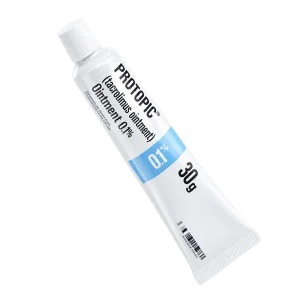
I used Protopic 0.1% on recurring facial eczema for several weeks. The warmth was uncomfortable for the first few applications, especially after a hot shower, but the itching settled before the redness fully disappeared. I found it easier to apply at night.
Several weeks 1 Nov 2026
Protopic
Adults and adolescents aged 16 years and over with moderate-to-severe atopic dermatitis may be prescribed Protopic 0.1% Ointment when topical treatment is needed for inflamed eczema.
Product information
Its active ingredient, tacrolimus, is a topical calcineurin inhibitor that reduces immune-driven skin inflammation without being a corticosteroid.
Ingredients
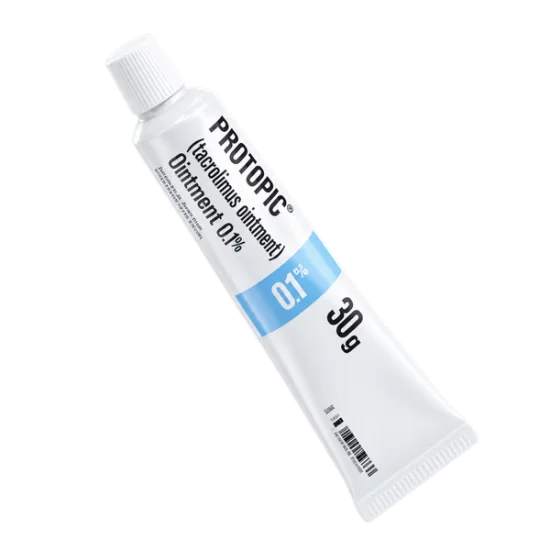
Protopic is a topical immunosuppressant supplied as an ointment in a tube. The product sold here is Protopic 0.1% Ointment, containing tacrolimus monohydrate equivalent to tacrolimus 0.1% w/w. The tube contains 30 g of ointment.
The ointment base contains inactive ingredients needed to create the correct texture and support skin application. Protopic is intended for external use only. Do not apply it inside the mouth, nose, eyes, or vagina.
Tacrolimus is not a topical corticosteroid. That difference matters for people who need a non-steroid anti-inflammatory option for sensitive areas or repeated flare management.
Therapeutic indications
Protopic is prescribed for atopic dermatitis, also called atopic eczema, when the condition is moderate to severe. The ointment reduces the activity of immune cells involved in an eczema flare. It is used on affected areas rather than as a general moisturiser for unaffected skin.
Dermatologists may select a topical calcineurin inhibitor when corticosteroids are unsuitable, have not controlled symptoms adequately, or need to be limited on areas such as the face, eyelids, neck, or skin folds. The Australian product information and regulatory guidance describe tacrolimus ointment as a prescription treatment for atopic dermatitis in appropriate age groups [1].
A flare and a maintenance phase are not the same clinical situation:
| Clinical phase | Typical skin features | Treatment focus |
|---|---|---|
| Active flare | Itching, redness, swelling, scaling, or oozing | Apply anti-inflammatory treatment to affected skin as prescribed |
| Improving phase | Less redness and itching, with residual dryness | Continue moisturiser and follow the prescribed treatment plan |
| Stable phase | No active inflammation but a history of recurrent eczema | Regular emollient use and a clinician-directed prevention plan |
Protopic should not be applied to skin with an active bacterial, viral, or fungal infection unless the infection has been assessed and managed. Cold sores, chickenpox-like blisters, crusting, pus, or rapidly worsening pain need prompt medical attention because immunomodulation can alter the local skin response.
A practical detail is easy to miss: moisturisers and Protopic can both be part of care, but they should not be mixed together in the palm. Apply them separately and allow the ointment to settle before applying another topical product.
Directions for use
Dosing differs between strengths and between users, so there is no single amount that suits everyone. For Protopic 0.1%, the prescribed regimen determines how often it is applied, which areas are treated, and whether it is used during active flares or in an intermittent prevention plan.
Use the ointment as follows:
- Apply a thin layer to affected skin only.
- Use the frequency specified by the prescriber.
- Avoid eyes, mucous membranes, open wounds, and infected areas.
- Wash hands after application unless the hands are being treated.
- Do not cover treated skin with airtight dressings unless specifically directed.
- Do not bathe, shower, or swim immediately after application because water can remove part of the ointment.
- Keep using an emollient for dryness, applying it separately from Protopic.
If a dose is missed, apply the next scheduled dose when appropriate. Do not apply a double layer. If the skin is rapidly deteriorating, becomes painful, develops yellow crusts, or forms blisters, the issue may be infection rather than an ordinary flare.
The ointment should not be used continuously without review. Treatment duration depends on response and recurrence pattern. Long-term intermittent use can be considered in selected patients, while uninterrupted daily use requires a clear clinical plan.
When not to use it
Protopic is not suitable for everyone.
Tacrolimus ointment has low systemic absorption when used correctly, although absorption can rise when large areas, broken skin, occlusive dressings, or prolonged intensive treatment are involved. People with Netherton syndrome, extensive skin disease, or impaired skin barrier function require specialist oversight.
Do not use live vaccines without discussing timing with the prescriber. The Australian Therapeutic Goods Administration and international product information also emphasise infection precautions and protection from excessive sunlight during treatment [3].
When this is not for you
This medication is not for you if:
- You have had a serious allergic reaction to tacrolimus or any ingredient in the ointment.
- You have an untreated infection on the area you want to treat.
- You have active eczema herpeticum or widespread herpes infection.
- You are using it on a rash that has not been diagnosed as atopic dermatitis.
- You are younger than the age authorised for the specific strength and indication.
- You have a severely weakened immune system unless a specialist has specifically directed treatment.
Avoid applying the ointment to malignant or pre-malignant lesions. Unusual nodules, persistent ulcers, non-healing sores, or rapidly changing skin need assessment rather than treatment with an eczema ointment.
Unwanted effects
The most frequent early effects are application-site burning, warmth, stinging, itching, or redness. These reactions often appear during the first few days and may lessen as the eczema settles. The Protopic prescribing information identifies application-site reactions as common adverse effects [2].
Other possible effects include:
- Increased sensitivity to heat or cold at the treated area.
- Folliculitis or inflamed hair follicles.
- Acne-like eruptions.
- Headache or flu-like symptoms in some users.
- Local herpes simplex infection, including cold sores.
- Skin infection when the affected area is already damaged or colonised by microbes.
Alcohol can cause facial flushing, warmth, or irritation in some people using tacrolimus ointment. This reaction is not an allergy in every case, but it can be uncomfortable and may be more obvious when the face is treated.
Avoid deliberate tanning and minimise unnecessary ultraviolet exposure. Tacrolimus ointment can increase concern about photoprotection because the treated skin is inflamed and sensitive, even though the medicine is not a conventional photosensitiser.
Rare but serious problems include severe allergic reactions, extensive infection, or swollen lymph nodes that persist. Seek urgent medical care for breathing difficulty, facial swelling, widespread blistering, or rapidly spreading skin pain.
One useful distinction: mild warmth that starts soon after application can be an expected local reaction; pus, honey-coloured crusting, increasing tenderness, and fever suggest infection and require medical assessment.
Mechanism of action
Tacrolimus belongs to the topical calcineurin inhibitor class. It enters inflammatory skin cells and reduces calcineurin-dependent signalling, which lowers the release of cytokines involved in redness, itching, and eczema inflammation. The medicine acts locally on the skin rather than providing the broad immune suppression associated with oral tacrolimus.
Common mistakes
Several habits reduce the benefit of topical tacrolimus:
- Applying it to damp skin immediately after washing.
- Covering the area with plastic film or airtight clothing.
- Using it on an undiagnosed rash.
- Applying it over impetigo, cold sores, or a fungal infection.
- Stopping all moisturiser once inflammation improves.
- Applying a thick layer because the skin feels severely itchy.
- Using tanning beds or deliberately sunbathing during treatment.
- Applying it close to the eyes or on the lips.
- Sharing the tube with another person.
- Treating a large area for an extended period without review.
A practical point concerns hand washing. If Protopic is being used on the hands, wash the hands before application, apply the ointment, and clean only the areas that do not need treatment. Otherwise, the medicine may be removed before it has had time to act.
Store the tube as directed and keep the cap closed. Do not transfer the ointment into another container, since this can cause contamination and makes correct identification harder.
Comparison
Protopic is one option within a broader atopic dermatitis treatment plan. The choice depends on inflammation severity, body location, skin thickness, previous treatment response, infection risk, and the patient’s age.
| Treatment category | Main action | Practical limitation |
|---|---|---|
| Tacrolimus ointment | Reduces calcineurin-driven inflammatory signalling | Early burning or warmth can occur |
| Topical corticosteroid | Suppresses several inflammatory pathways | Potency, duration, and body site require careful selection |
| Emollient or barrier-repair therapy | Reduces water loss and supports the skin barrier | Does not control moderate or severe inflammation alone |
Topical corticosteroids often reduce inflammation quickly during an acute flare. Protopic may be selected when a steroid-sparing approach is desirable, such as repeated facial eczema or recurrent inflammation in skin folds. Emollients remain useful with either approach because atopic dermatitis involves impaired barrier function as well as immune inflammation.
These treatments are not interchangeable by strength or application schedule. A low-potency corticosteroid may be suitable for one location, while tacrolimus may be preferable for another. The clinical goal is to control inflammation while limiting avoidable irritation and treatment-related skin problems.
What doctors say
Dermatologists generally judge Protopic by reduced itch, less redness, fewer flare days, and improved sleep rather than by immediate cosmetic change. The skin may feel different. Appearance can improve later. Monitor the treatment response.
A common clinical mistake is stopping after one or two applications because of burning. Mild early irritation can settle, while untreated inflammation continues to damage the skin barrier. A second mistake is using the ointment on every dry patch without confirming whether that patch is active eczema.
Doctors also assess treatment location. Facial skin, eyelids, neck, and folds often need a different strategy from thickened plaques on the limbs. The right medicine for one body site may not be the right medicine for another.
Clinical guidance from the European Medicines Agency supports a structured approach to tacrolimus ointment, with attention to age, disease severity, infection, sunlight exposure, and intermittent maintenance use [4]. In practice, a treatment plan works best when the patient knows which areas to treat, how often to apply the ointment, and when a flare needs reassessment.
What customers often ask
How soon does the effect of Protopic become noticeable?
Early itching and burning may change within the first few applications, while visible improvement can take longer. The 2023 FDA prescribing information describes improvement during treatment. Clinical trials reviewed by the FDA found that tacrolimus ointment improved signs and symptoms of atopic dermatitis during the treatment period. The response varies with disease severity, body site, skin thickness, and whether infection is present. Improvement should be judged over the prescribed course rather than after a single application.
How long does a Protopic course last, and is long-term use acceptable?
A course lasts according to the treatment plan and the patient’s response. The 2023 EMA product information supports intermittent use in selected patients. Protopic may be used for an active flare and, in selected patients, intermittently to reduce recurrent flares. Long-term continuous daily use should not continue without medical review. The World Health Organization describes topical immunomodulators as treatments requiring appropriate patient selection and monitoring when used for recurring inflammatory skin disease.
Do you offer anonymous delivery?
Your order will be securely packed and shipped within 24 hours. This is exactly what your package will look like (images of an actual item sent). It has the size and look of a regular private letter (24x11x0.7 cm) and its contents cannot be seen.
Comparison
Sources
- Therapeutic Goods Administration (2024). Protopic ointment: Australian Product Information.
- U.S. Food and Drug Administration (2023). Protopic (tacrolimus) ointment prescribing information.
- Therapeutic Goods Administration (2024). Tacrolimus ointment: safety and product information.
- European Medicines Agency (2023). Protopic: European public assessment report and product information.
How Buyers Rate Protopic
Based on 3 reviews
Protopic 0.1% helped a stubborn patch around my neck after other treatments had irritated the area over several weeks. I disliked the greasy feel under a work shirt, and one flare returned when I stopped moisturising. The improvement was useful, but it was not immediate.
Several weeks 5 Oct 2026Protopic 0.1% reduced the frequency of my hand and elbow flares over the following months. I experienced burning at the start and had to avoid applying it straight after exercise. The treatment worked best when I followed the schedule instead of adding extra ointment during itchy periods.
The following months 19 Oct 2026