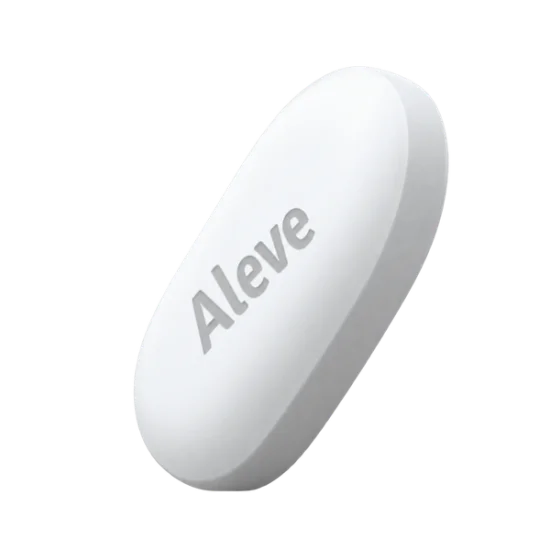
At the recommended dose for several days, he used Aleve of lower-back strain and said the longer relief helped him sleep. He noticed mild heartburn when he took a tablet before breakfast, which settled after taking it with food.
Several days 25 Oct 2026
Aleve
Aleve tablets are taken by mouth for short-term relief of pain and inflammation. They contain naproxen sodium, an NSAID used for headaches, muscle aches, period pain, joint discomfort, and minor…
Aleve tablets are taken by mouth for short-term relief of pain and inflammation. They contain naproxen sodium, an NSAID used for headaches, muscle aches, period pain, joint discomfort, and minor arthritis symptoms.
Product information
Naproxen sodium is converted to naproxen after absorption. The active substance then inhibits cyclo-oxygenase enzymes, commonly called COX-1 and COX-2.
Ingredients
Aleve contains naproxen sodium, a non-steroidal anti-inflammatory drug in the propionic acid class. Naproxen sodium reduces the production of prostaglandins, chemical messengers involved in pain, swelling, fever, and inflammation. The tablet form is swallowed with water and should be used at the lowest amount that controls symptoms.
Therapeutic indications
Aleve may help relieve mild to moderate pain associated with inflammation. Common uses include:
- Headache and tension-related head pain
- Toothache
- Backache and muscle aches
- Sprains and strains
- Period pain
- Minor arthritis pain
- Joint stiffness and inflammatory discomfort
- Fever associated with minor illness
Naproxen sodium tends to be more useful when pain continues for several hours or returns repeatedly during the day. It may reduce pain intensity, swelling, and movement-related stiffness. Relief is not guaranteed, and pain caused by infection, fracture, nerve compression, or a serious abdominal condition requires medical assessment rather than repeated self-treatment.
| Symptom pattern | Likely role of Aleve | Expected response |
|---|---|---|
| Short-term muscle or joint pain | Reduces inflammatory pain and stiffness | Improvement may develop after absorption |
| Period pain or headache | Reduces prostaglandin-related pain | Relief may continue for several hours |
| Persistent arthritis symptoms | May reduce pain and stiffness | Requires a planned treatment approach |
Aleve should not be used to mask severe or unexplained pain for several days. Pain with chest pressure, weakness on one side, black stools, vomiting blood, severe abdominal tenderness, or breathing difficulty needs urgent medical care.
Directions for use
The appropriate amount and frequency depend on the purpose of use and are agreed with a doctor or pharmacist. Use Aleve only according to the product’s approved directions or the personalised instructions supplied by a healthcare professional.
Practical administration points include:
- Take the tablet by mouth with water.
- Take it with food or milk if it causes stomach discomfort.
- Use the lowest amount that controls symptoms.
- Keep within the maximum daily amount for the specific Aleve product.
- Avoid taking another NSAID at the same time.
- Do not extend self-treatment when pain is worsening or repeatedly returning.
- Do not give adult-strength NSAID treatment to a child unless a clinician has provided dosing instructions.
For older adults, people with reduced kidney function, and those with a history of ulcers, the appropriate regimen may be lower, shorter, or unsuitable. Naproxen can increase blood pressure and fluid retention, which matters in heart failure, kidney disease, and poorly controlled hypertension.
If a dose is missed, take it when remembered unless the next scheduled dose is near. Do not double the next dose. If too much has been taken, urgent advice is needed because early symptoms can be mild even when stomach, kidney, or cardiovascular complications are developing.
When not to use it
Naproxen may interact with warfarin and other anticoagulants, aspirin, corticosteroids, selective serotonin reuptake inhibitors, lithium, methotrexate, ciclosporin, tacrolimus, diuretics, ACE inhibitors, and angiotensin-receptor blockers. These combinations can increase bleeding, kidney, blood pressure, or toxicity risks. The WHO lists NSAID-related gastrointestinal and renal injury among recognised medicine-safety concerns.[3]
Aleve should be avoided or used only under specific medical direction in people with:
- Previous allergic reaction to naproxen, aspirin, or another NSAID
- NSAID-triggered asthma, wheezing, nasal swelling, or hives
- Active stomach or intestinal ulcer
- Previous gastrointestinal bleeding caused by an NSAID
- Severe kidney or liver impairment
- Severe heart failure
- Recent or planned coronary artery bypass surgery
- Pregnancy after 20 weeks unless specifically directed, and especially during the third trimester
- Unexplained gastrointestinal bleeding
When this is not for you
Aleve is not suitable for everyone. NOT for you if you have an NSAID allergy, active ulcer, severe kidney disease, or late pregnancy unless a clinician advises otherwise.
Pregnancy and breastfeeding require a specific assessment. NSAIDs can affect fetal circulation later in pregnancy, and use near delivery can create additional risks. Naproxen may pass into breast milk, so the choice and duration should be decided with a clinician.
Unwanted effects
Common NSAID-related problems include indigestion, stomach pain, nausea, heartburn, and diarrhoea. Some people develop headache, dizziness, fluid retention, or a rise in blood pressure. Taking naproxen with food can reduce upper-stomach discomfort, but it does not remove the risk of ulceration or bleeding.
Stop using Aleve and obtain urgent medical help for:
- Black or bloody stools
- Vomiting blood or material resembling coffee grounds
- Severe or persistent stomach pain
- Facial swelling, wheezing, or difficulty breathing
- A widespread blistering or peeling rash
- Sudden weakness, slurred speech, or chest pain
- Markedly reduced urine output or sudden swelling
NSAIDs can cause gastrointestinal bleeding without much warning. The risk rises with older age, previous ulcers, higher doses, longer treatment, alcohol excess, corticosteroids, anticoagulants, antiplatelet drugs, and selective serotonin reuptake inhibitors. The EMA identifies these risks within its regulatory information for naproxen and other NSAIDs.[2]
Alcohol can increase stomach irritation and may worsen dizziness. Regular heavy alcohol use also adds to the risk of gastrointestinal bleeding and liver complications when other pain medicines are involved.

Mechanism of action
The active substance then inhibits cyclo-oxygenase enzymes, commonly called COX-1 and COX-2. This lowers prostaglandin formation in inflamed tissues. The same process also explains some unwanted effects, because prostaglandins help protect the stomach lining and support kidney blood flow.[1]
The anti-inflammatory action makes naproxen sodium useful when pain involves swelling, stiffness, or irritated joints. Paracetamol can reduce pain and fever but does not provide the same anti-inflammatory activity. Ibuprofen also inhibits COX enzymes, while naproxen generally remains active for longer.
Common mistakes
- Taking Aleve together with ibuprofen or another NSAID
- Repeating a dose early because relief has not started
- Using it for several days without reassessing persistent pain
- Taking it on an empty stomach despite previous indigestion
- Ignoring black stools, vomiting blood, or sudden swelling
- Forgetting to mention warfarin, aspirin, steroids, or blood-pressure medicines
- Using it during late pregnancy without medical direction
- Taking extra tablets after alcohol because the pain feels stronger
- Assuming a longer-lasting NSAID is automatically safer than a shorter-acting one
One practical mistake deserves special attention: people often measure treatment by pain relief alone. Less pain does not prove that the underlying injury has healed, and it does not protect against ulcer, kidney, or cardiovascular complications.
Comparison
Naproxen sodium, ibuprofen, and paracetamol have different pharmacological profiles. The table compares categories rather than individual commercial formulations.
| Active ingredient | Main action and typical duration | Main limitation |
|---|---|---|
| Naproxen sodium | NSAID with anti-inflammatory activity and relatively prolonged action | Stomach, kidney, blood pressure, and cardiovascular risks |
| Ibuprofen | NSAID with anti-inflammatory, pain-relieving, and fever-reducing activity | Shorter action for some users; similar NSAID risks |
| Paracetamol | Pain and fever relief with little peripheral anti-inflammatory activity | Excess use can cause serious liver injury |
Aleve may be preferable for inflammatory pain that persists for much of the day. Ibuprofen may be selected when a shorter-acting NSAID is preferred. Paracetamol can be considered when inflammation is not central or when NSAIDs are unsuitable, although liver safety becomes the key concern.
A person with a stomach ulcer history, kidney impairment, anticoagulant treatment, heart disease, or uncontrolled hypertension may need an alternative approach. The right choice depends on the cause of pain, current medicines, age, and medical history.
What doctors say
In clinical practice, doctors usually assess three issues before recommending naproxen: the source of pain, the expected treatment duration, and the person’s risk of bleeding or kidney injury. An anti-inflammatory can be a sensible short-term option for a strained joint or period pain, yet the same medicine may be unsuitable for recurrent stomach bleeding or advanced kidney disease.
A clinician would expect improvement within the treatment window appropriate for the condition. Pain that remains severe, worsens, or returns as soon as each dose wears off can signal a problem requiring diagnosis rather than more tablets.
Doctors also look for hidden duplication. A person may take Aleve, an ibuprofen product, and a cold remedy containing an NSAID without realising that the medicines overlap. Another frequent issue is continuing self-treatment because the tablets still provide partial relief while the original condition progresses.
What customers often ask
Can alcohol be used while taking Aleve?
Alcohol can increase stomach irritation and may raise the risk of gastrointestinal bleeding with naproxen. The TGA’s 2025 safety information for NSAIDs supports limiting alcohol exposure when gastrointestinal risk factors are present. Alcohol can also worsen dizziness and make it harder to recognise early adverse effects.
How long can a course last, and is long-term use acceptable?
The course length depends on the cause of pain, age, kidney function, ulcer history, and other medicines. EMA safety guidance available in 2025 continues to support the shortest duration that controls symptoms, because prolonged NSAID exposure increases gastrointestinal, kidney, blood pressure, and cardiovascular risks. Long-term use should be planned and monitored by a clinician rather than continued because the tablets remain available.
What should happen if the expected pain relief does not come?
Do not keep increasing the amount or add ibuprofen to compensate. NICE guidance current in 2025 supports reassessing persistent or unexplained pain, especially when function is worsening or symptoms are severe. Urgent assessment is needed for chest pain, neurological symptoms, severe abdominal pain, breathing difficulty, or gastrointestinal bleeding.
What should happen after a missed dose?
Take the missed dose when remembered only if the next planned dose is not close. The TGA’s 2024 consumer medicine guidance advises avoiding double dosing after a missed medicine dose. If the next dose is due soon, skip the missed dose and return to the agreed schedule.
What happens after stopping Aleve, and is tapering required?
Naproxen does not normally require tapering when used for a short course. Its pain-relieving and anti-inflammatory effects fade after the medicine is cleared, so the original pain may become noticeable again. The WHO’s 2023 medicine-safety principles support reviewing recurring symptoms rather than restarting or extending treatment without a clear plan.
Which condition rules out Aleve?
An active stomach or intestinal ulcer, or previous NSAID-related gastrointestinal bleeding, is a clear reason to avoid self-treatment with Aleve. EMA regulatory information reviewed in 2025 identifies these patients as having a higher risk of serious bleeding. A history of NSAID-triggered asthma, severe kidney disease, or late pregnancy also requires avoidance unless a clinician gives specific instructions.
Do you offer anonymous delivery?
Your order will be securely packed and shipped within 24 hours. This is exactly what your package will look like (images of an actual item sent). It has the size and look of a regular private letter (24x11x0.7 cm) and its contents cannot be seen.
Comparison
Sources
- U.S. Food and Drug Administration (2024). Aleve (naproxen sodium) Drug Facts Label.
- European Medicines Agency (2012). European Medicines Agency recommendations on non-selective NSAIDs.
- World Health Organization (2023). Medication safety in polypharmacy: technical report.
How Buyers Rate Aleve
Based on 3 reviews
At the recommended dose, he tried Aleve for knee pain and felt less stiffness during the first day. He stopped after developing ankle swelling and arranged a medication review because he was also taking treatment for blood pressure.
The first day 31 Oct 2026At the recommended dose, he used it for recurring shoulder pain and found the benefit incomplete after the first few doses. The pain returned each time the effect faded, so he sought assessment instead of extending the course himself.
The first few doses 5 Oct 2026