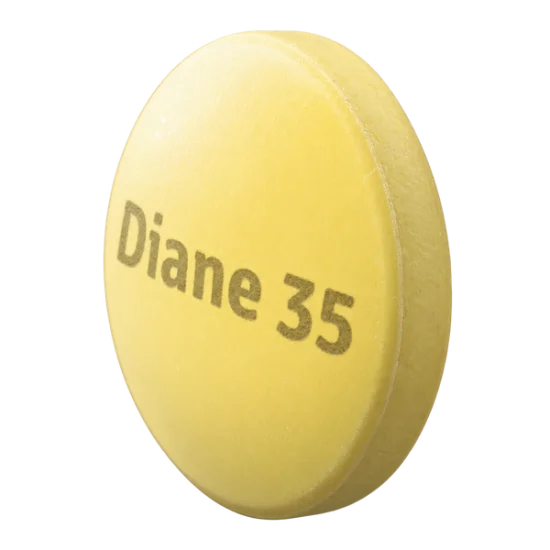
used Diane 35 for several months after persistent jawline acne and reported that the skin improved gradually. She described mild nausea during the first cycle, which became less troublesome when the tablet was taken with an evening meal.
Several months 3 Nov 2026
Diane 35
Women with clinically significant androgen-related acne, excess facial or body hair, or cycle disturbance may be prescribed Diane 35 after medical assessment. Diane 35 is an oral hormonal tablet used…
Women with clinically significant androgen-related acne, excess facial or body hair, or cycle disturbance may be prescribed Diane 35 after medical assessment. Diane 35 is an oral hormonal tablet used when androgen activity contributes to these symptoms. It also provides contraceptive protection during treatment, but it is not intended solely for contraception.
Product information
Diane 35 is a prescription hormonal tablet used in women with androgen-dependent dermatological symptoms. Its clinical role is linked to reducing the effects of androgen hormones, which can contribute to persistent acne, oily skin, unwanted hair growth, and irregular menstrual cycles.
Treatment decisions depend on the severity of symptoms, medical history, age, smoking status, migraine history, blood-pressure readings, and the presence of blood-clot risk factors. A clinician may also assess whether symptoms suggest polycystic ovary syndrome (PCOS) or another endocrine condition.
The product is taken orally in tablet form. The specific regimen depends on the prescribed strength, treatment plan, and individual risk profile.
Active ingredient profile
Diane 35 belongs to the combined anti-androgenic hormonal medicine category. Its therapeutic action is designed to reduce androgen stimulation while providing an oestrogen component that supports cycle control.
Cyproterone acetate is the anti-androgenic component associated with blocking androgen activity at target tissues. Ethinylestradiol is the oestrogen component associated with suppression of ovarian androgen production and regulation of the hormonal cycle. These two substances are widely discussed in clinical guidance for androgen-related symptoms in women.
Ingredients
Diane 35 belongs to the combined anti-androgenic hormonal medicine category. Its therapeutic action is designed to reduce androgen stimulation while providing an oestrogen component that supports cycle control.
Cyproterone acetate is the anti-androgenic component associated with blocking androgen activity at target tissues. Ethinylestradiol is the oestrogen component associated with suppression of ovarian androgen production and regulation of the hormonal cycle. These two substances are widely discussed in clinical guidance for androgen-related symptoms in women.
Therapeutic indications
Diane 35 may be prescribed for moderate to severe androgen-dependent acne, especially when topical treatment or other approaches have not produced adequate improvement. It can also be used for hirsutism, which means excessive terminal hair growth in areas influenced by androgen hormones.
Women with PCOS may experience acne, hirsutism, irregular periods, or scalp hair thinning. Diane 35 can help control some of these manifestations, although it does not remove the underlying tendency toward PCOS or correct every metabolic feature of the condition.
Clinicians usually evaluate:
- The severity and duration of acne.
- Facial or body hair growth and its progression.
- Menstrual regularity.
- Weight changes and signs of insulin resistance.
- Blood pressure and migraine history.
- Previous or current use of hormonal medicines.
- Personal or family history of venous thrombosis.
- Possible pregnancy before treatment begins.
Diane 35 should not be used as a routine first choice for simple contraception when androgen-related symptoms are absent. Its role is linked to therapeutic management of androgen-sensitive conditions, and treatment is normally reviewed after symptoms improve.
Improvement is gradual. Skin inflammation may settle before excess hair growth changes, because existing hairs remain in their growth cycle. Hair-related improvement often requires longer observation than acne improvement.
Directions for use
The treatment schedule is usually organised around a repeating tablet cycle, with a break or inactive-tablet interval determined by the prescribed product and clinical plan. Do not create an extra break, extend the break, or restart early without specific medical instructions.
Practical administration points include:
- Take each tablet at the prescribed time.
- Swallow the tablet with water.
- If vomiting or severe diarrhoea occurs soon after dosing, ask for specific missed-dose instructions because absorption may be incomplete.
- If a tablet is missed, follow the product-specific missed-dose advice supplied by the prescriber or dispensing service.
- Do not double the next dose unless a clinician has instructed this.
- Tell the prescriber about medicines used for epilepsy, tuberculosis, HIV, hepatitis C, or herbal products containing St John’s wort, because enzyme induction can reduce hormonal contraceptive reliability.
- Use additional contraceptive advice when a clinician identifies reduced hormonal protection.
A course may continue for several months when the treatment is tolerated and symptoms remain clinically relevant. Reassessment is needed if improvement is absent, if symptoms return quickly, or if treatment continues for an extended period.
When not to use it
- Current or previous deep-vein thrombosis or pulmonary embolism.
- A known thrombophilia or a major inherited clotting disorder.
- Previous stroke, heart attack, or significant arterial disease.
- Migraine with aura.
- Severe liver disease or a liver tumour.
- Unexplained vaginal bleeding that has not been assessed.
- Known or suspected pregnancy.
- A meningioma or history of meningioma where cyproterone exposure is contraindicated.
- A serious allergy to a component of the medicine.
Drug interactions may reduce contraceptive reliability or alter hormone exposure. Important examples include enzyme-inducing medicines used for epilepsy, rifampicin-type antibiotics, some HIV or hepatitis C treatments, and St John’s wort. Some medicines can also affect potassium levels or liver function, so a complete medication list is needed before prescribing.
Diane 35 should not be combined with another hormonal contraceptive unless a prescriber has given a specific plan. Combining hormonal products can increase exposure without providing a clear therapeutic advantage.
When this is not for you
Diane 35 is not suitable for everyone. NOT for you if you have a history of thrombosis, migraine with aura, or another listed contraindication.
Smoking increases vascular risk, especially with increasing age. Obesity, uncontrolled hypertension, major surgery, prolonged immobility, and a strong family history of thrombosis also require careful assessment.
Unwanted effects
Common adverse effects can include nausea, breast tenderness, headache, mood changes, abdominal discomfort, changes in bleeding pattern, and fluid retention. Some women experience spotting during the first treatment cycles.
These effects may settle as the body adapts, although persistent or severe symptoms require review. Diane 35 can also worsen mood in susceptible individuals. New or marked depression should be reported promptly.
The most serious concern is venous thromboembolism. Symptoms that need urgent medical assessment include:
- One-sided leg swelling, pain, warmth, or tenderness.
- Sudden shortness of breath.
- Chest pain that worsens with breathing.
- Coughing blood.
- Sudden weakness, numbness, speech difficulty, or visual loss.
- A severe, unusual headache with neurological symptoms.
Cyproterone-containing treatment has also been associated with meningioma risk, especially with higher cumulative exposure. A new persistent headache, vision change, hearing change, loss of smell, seizures, or limb weakness requires medical assessment.
Mechanism of action
Androgens are hormones that influence sebaceous glands, hair follicles, and reproductive tissues. Excess androgen activity can increase sebum production, encourage blocked pores, and stimulate coarse hair growth in androgen-sensitive areas.
Cyproterone acetate reduces androgen effects by antagonising androgen receptors. It also has progestogenic activity, which contributes to its hormonal effects. By reducing androgen stimulation at the skin and hair follicle, it can lessen sebum production and slow the development of new androgen-dependent hair growth.
Ethinylestradiol contributes to cycle regulation and reduces ovarian androgen activity through suppression of gonadotrophin signalling. The oestrogen component also increases hepatic production of sex hormone-binding globulin, which can reduce the proportion of circulating testosterone available to act on tissues.
The combined result is a lower androgen effect at the skin and hair follicle. This can support improvement in hormonal acne and hirsutism, while the menstrual cycle becomes more predictable during use.
Diane 35 works through a different balance of hormonal actions from a standard topical acne treatment. Topical retinoids and benzoyl peroxide act directly within the skin, while Diane 35 acts through systemic endocrine pathways. A topical approach may be preferred for mild acne, whereas systemic hormonal treatment may be considered when acne is persistent, widespread, or accompanied by hirsutism.
The European Medicines Agency has reviewed cyproterone-containing medicines in relation to treatment benefits and meningioma risk, especially with prolonged or repeated exposure [1]. The U.S. Food and Drug Administration and the National Institute for Health and Care Excellence also publish guidance relevant to hormonal treatment and thromboembolic risk. Treatment duration therefore needs clinical review rather than automatic continuation.

Common mistakes
Several practical errors can reduce treatment reliability or delay recognition of a serious problem:
- Starting Diane 35 solely for contraception without discussing the therapeutic indication.
- Stopping after a few weeks because acne has not changed.
- Taking tablets at widely different times each day.
- Ignoring vomiting or severe diarrhoea after a dose.
- Using enzyme-inducing medicines without reporting them.
- Continuing treatment after developing migraine with aura.
- Treating one-sided leg swelling as a routine muscle strain.
- Assuming that a lower risk at a younger age means clot symptoms can be ignored.
- Taking another hormonal contraceptive at the same time without a prescriber’s direction.
- Failing to mention a history of meningioma or unexplained neurological symptoms.
One easily missed detail is the difference between gradual hair-cycle improvement and immediate hair removal. Diane 35 may reduce new androgen-dependent growth, but it does not remove existing hair.
Comparison
| Approach | Main therapeutic action | Typical clinical role |
|---|---|---|
| Diane 35 | Systemic anti-androgenic hormonal action | Androgen-dependent acne or hirsutism with a need for hormonal cycle control |
| Topical acne treatment | Direct action within the skin | Mild to moderate acne without prominent hormonal features |
| Non-oestrogen hormonal option | Different hormonal or contraceptive pathway | Situations where oestrogen is unsuitable or clot risk needs to be minimised |
Diane 35 may be useful when acne is accompanied by hirsutism or irregular periods. Its limitation is systemic exposure, including oestrogen-related clot risk and possible hormonal adverse effects.
Topical treatment avoids systemic hormonal exposure but may not address androgen-driven symptoms outside the skin. A non-oestrogen option may suit some women with oestrogen contraindications, although it may not provide the same anti-androgenic effect.
Choice depends on the clinical problem, not on acne alone. A woman with severe acne and migraine with aura may require a different strategy from a woman with acne, hirsutism, and no vascular risk factors.
What doctors say
Clinicians generally assess the reason for treatment before selecting Diane 35. Acne alone may be managed with topical treatment, while acne combined with hirsutism or irregular periods can prompt an endocrine assessment.
A doctor may explain that skin improvement takes time and that stopping once the first improvement appears can allow symptoms to return. Hair growth also changes slowly because established hairs are not removed by hormonal treatment.
The balance of benefit and risk changes during treatment. A new migraine pattern, smoking initiation, major operation, prolonged immobility, or a new medicine can require an immediate review.
The WHO medical eligibility framework supports structured assessment of medical conditions and risk factors before combined hormonal use [2]. Clinical review is also needed when treatment continues beyond the period originally planned.
What customers often ask
Can women under 18 use Diane 35?
Use in adolescents requires an individual clinical assessment, including confirmation of the diagnosis and review of alternative treatments. The TGA's regulatory approach to combined hormonal medicines supports consideration of age, clot risk, migraine history, and sexual-health needs before prescribing, with current practice assessed in 2026. Diane 35 should not be started by a person under 18 without a prescriber’s decision.
What should happen if the expected result does not appear?
The prescriber should reassess the diagnosis, adherence, treatment duration, and other causes of acne, hirsutism, or irregular periods. EMA safety and therapeutic guidance supports reviewing continued cyproterone exposure when the clinical benefit is limited, and this remains relevant to treatment decisions in 2026. Do not increase the dose or add another hormonal product independently.
Can Diane 35 be used during pregnancy or breastfeeding?
Diane 35 is not used during pregnancy, and pregnancy should be excluded when clinically appropriate before treatment begins. WHO guidance on hormonal medicines states that pregnancy and breastfeeding require a separate contraceptive and medication assessment, with recommendations current in clinical use in 2026. If pregnancy occurs during treatment, stop taking further tablets and obtain prompt medical advice about the next step.
Do diet, exercise, or daily habits affect the result?
Healthy eating, regular physical activity, adequate sleep, and avoiding smoking can support general hormonal and cardiovascular health. The TGA's safety approach to combined hormonal therapy makes smoking status, body weight, blood pressure, and mobility relevant to the risk assessment in 2026. These habits cannot replace treatment for severe acne or hirsutism, and crash dieting may worsen menstrual irregularity.
Can the tablet be split, crushed, or chewed?
The tablet should be swallowed whole with water unless a prescriber or pharmacist gives a specific alternative instruction. EMA product information for oral hormonal medicines treats intact administration as the standard approach, and this remains the practical method in 2026. Crushing or chewing can make administration inaccurate and may be unpleasant, so a different dosage form should be discussed if swallowing is difficult.
Can older adults use Diane 35?
Use in older adults requires careful reassessment because age can increase the likelihood of vascular disease, hypertension, migraine, liver problems, and other contraindications. WHO contraceptive guidance places age alongside smoking, cardiovascular disease, and thrombotic risk when hormonal treatment is considered, with these principles still applied in 2026. A woman who has reached menopause generally requires a different assessment because the original acne, hirsutism, or contraceptive indication may no longer apply.
Do you offer anonymous delivery?
Your order will be securely packed and shipped within 24 hours. This is exactly what your package will look like (images of an actual item sent). It has the size and look of a regular private letter (24x11x0.7 cm) and its contents cannot be seen.
Comparison
Sources
- European Medicines Agency (2013). Cyproterone-containing medicinal products — Article 31 referral.
- WHO (2015). Medical eligibility criteria for contraceptive use, fifth edition.
How Buyers Rate Diane 35
Based on 3 reviews
used the tablets for acne with irregular periods. She reported more predictable bleeding, but headaches became frequent enough for her prescriber to review the treatment and discuss another option.
5 Oct 2026had previously used hormonal treatment for androgen-related symptoms and described improvement in oily skin. She also reported breast tenderness and stopped after a clinical review because her changing health profile made continued oestrogen exposure unsuitable.
20 Oct 2026